Showing posts with label gadgets. Show all posts

Saturday, 13 December 2014

Assasin's Creed Unity Review


Summary: The city: 1789 Paris. The French Revolution transforms a once-magnificent city into a hot house of terror and calamity. Its cobblestone streets run red with the blood of the proletariat who dared to rise up against the oppressive aristocracy. As the nation is in upheaval, a man named Arno leaves on a journey to expose the true powers of the Revolution. His mission throws him into the middle of a ruthless struggle for the fate of a nation, and transform him into a real Master Assassin. From the storming of the Bastille to the execution of King Louis XVI, experience the French Revolution as never before, and help the people of France carve an entirely new destiny.

  1. Initial release date: November 11, 2014
  2. Series: Assassin's Creed
  3. Publisher: Ubisoft
  4. Platforms: Xbox One, PlayStation 4, Microsoft Windows
  5. Developers: Ubisoft Montreal, Griptonite Games, Ubisoft Annecy


Assassin’s Creed Unity Minimum and Recommended Requirements

Minimum Requirments:
CPU:Intel Core i5-2500K @ 3.3 GHz or AMD Phenom II x4 940 @ 3.0 GHz or AMD FX-8350 @ 4.0 GHz
CPU Speed:Info
RAM:6 GB
OS:Windows 7 SP1, Windows 8/8.1 (64-bit operating system required)
Video Card:NVIDIA GeForce GTX 680 or AMD Radeon HD 7970 (2 GB VRAM)
Sound Card:Yes
Free Disk Space:50 GB

Recommended Requirements:
CPU:Intel Core i7-3770 @ 3.4 GHz or AMD FX-8350 @ 4.0 GHz or better
CPU Speed:Info
RAM:8 GB
OS:Windows 7 SP1, Windows 8/8.1 (64-bit operating system required)
Video Card:NVIDIA GeForce GTX 780 or AMD Radeon R9 290X (3 GB VRAM)
Sound Card:Yes
Free Disk Space:50 GB


Assassin's Creed Unity's next big patch set for release on 15/12/2014


Assassin's Creed Unity's Patch 4 is set for release across all platforms next Monday, Dec. 15, according to a post on the franchise's official website.
"This patch will address issues with stability and performance as well as online matchmaking and connectivity (among other fixes and improvements)," the post reads.
A Ubisoft Q&A said that the developer expects Patch 4 "to rectify most of the remaining issues our players have been reporting." Those include problems with Assassin's Creed Unity crashing, freezing and slowing its frame rate.
Assassin's Creed Unity launched last month for PlayStation 4, Xbox One and Windows PC amid a host of problems. 

Saturday, 4 October 2014

3 Reasons Why Apple's iWatch Will Be A Gorgeous Flop

The race to own the wrist is in full swing ‒ and Apple hasn't even arrived. With less than two weeks to go (likely September 9th), here are three reasons why I think the iWatch will be a flop. The watch will be gorgeous, to be sure, but it won't come close to rivaling the adoption rate of other Apple tech.
The first hurdle is that it's really an evolutionary product category. Unlike the iPod, or iPhone or iPad, Apple isn't really inventing a new device ‒ it's working on a first release of a product that already has some big names staking out their claim in this category. Samsung (now on its 6th version), Motorola, LG and Withings to name a few.
Also, unlike the iPod, the iPhone and the iPad, we've owned and worn "wrist wearables" for generations. The iPod, the iPhone and the iPad were largely created from whole cloth - as standalone separate devices.
I'm not a watch connoisseur, but recent designs and aesthetics have come a long way from the clunky LCD blocks that comprised "first generation" wearable's for the wrist. Here's what a sampling of that competition looks like today ‒ which is to say not too shabby in their own right.
The second reason is the sheer amount of design hype. We've been teased and taunted for well over a year ‒ and trying to just guess what it might look like has been the personal hobby of some very sharp designers. The risk here is that the final iWatch design won't be that revolutionary from either the competition (above) ‒ or the fantasy design projects we've all seen before (below). So far, many of these have been elegant and impressive attempts to answer the fundamental question ‒ what could an iWatch look like?
With all of these as design placeholders, the iWatch reveal (always a big stage moment) just won't have the same wow factor as the iPod, the iPhone or the iPad. Once it is revealed ‒ we'll move at lightning connector speed into the third big hurdle ‒ value.
Price alone is perhaps the lowest threshold for diehard Apple fans because they're all very comfortable with expensive products that look elegant and make the right tech "statement." While the retail price is still unknown, it's been widely speculated to be about $300. I think it could easily be more because most of Apple's products tend to push pricing boundaries simply because they can.
Value, however, is a larger component than price ‒ and this is where the iWatch is basically an expensive addition or companion device to the iPhone itself. That's not unique to Apple because every version of wearable watch so far (including those from Samsung, Withings, LG and Motorola) lean heavily on the core component ‒ the one device you may return home to retrieve ‒ the smartphone itself. That means that whatever the final price of the iWatch ‒ $300, $400 ‒ or more, it's still just an expensive accessory. It will enhance the functionality of the iPhone ‒ and will collaborate seamlessly with it, but it won't replace it ‒ and that's a big challenge for all the wrist wearable manufacturers ‒ including Apple.
Even 'The Woz' (Apple Co-Founder Steve Wozniak) thinks the whole wearable category is a big risk for everyone ‒ including Apple.
"I feel that wearables are a hard sell. They are go-betweens for your smartphone but are an extra piece and need special advantages that the smartphone doesn't have, in my opinion. If they are just a Bluetooth go-between then it could wind up in the category of Bluetooth headsets: Fun to wear and show off for a day." Apple Co‒FounderSteve Wozniak ‒ C|Net article
In terms of hype, here's how Morgan Stanley is forecasting the adoption rate relative to other laudable Apple successes.
Don't get me wrong, the launch will be an exciting event - and the iWatch will be a typically impressive design achievement, but it won't be the breakthrough we've all come to expect from one of the worlds biggest tech giants. Given the high expectations, the wildly bullish forecasts by analysts and the competition already on the global stage, I think we'll look back this time next year and say that this first version of the iWatch was a flop.

Friday, 26 September 2014

Wearing Your #LifeHacks


If you were among the many who tuned into last week's Apple Live event you were probably excited by the announcement of the Apple Watch. It's interesting to see how technology is evolving into an ever more personable, wearable platform and is transforming beyond the smartphone, tablet and PC.
The interesting part of the entire announcement was how applications would morph and shape as a result of wearing something that has a monitor 85% less the surface size of a modern smartphone. Since it's impossible to type on the device: voice activation or one touch will be a huge factor in how the device works. It's also unlikely many will use it for heavier lifts like online banking or gaming. At least not yet. Those areas will come in time, however for now it does open up a whole new threshold: applications built around quick, simple efficiencies and areas of productivity. We are now entering the formalized era of wearing personalized utility.
Life hacking is nothing new. It's been around as long as others have used storytelling to share how to enhance one's life or work in many areas. From improved self-awareness, personal efficiency, weight loss, health improvements, exercise, memorization, nutrition, multitasking, removing red wine from a white carpet, getting stains out of clothing, moving from a server to the cloud, learning to play soccer, riding a bike while wearing a skirt, etc.
The first personal life hacking digital app I used was back in 2006 with Nike+. I affixed a sensor to my shoe which kept track of the mileage I ran synchronized with my iPod. The program helped me improve my art of running so that I could be harder, better, faster, stronger. Yet the first wearable life hack I really used that I recollect wasn't digital at all. In fact it was when a German professor who taught with my late father told me to don a pair of cleats in 1979 to properly play the sport of soccer. Up until that time I wore flat canvas sneakers with no traction. Cleats or "boots" as many call them in the U.K. helped me become a better player at an early age when the footwear was still uncommon in the youth game stateside. Boots helped with mobility, kicking the ball with more power and prevented injuries by being more sturdy than a canvas sneaker. Suggestions like this have been around us forever, it's just now they will be more digital and data driven based on our own personal metrics and how we want to integrate those metrics with others in the world at large.
This scalable wearable tech landscape now opens up a whole new economy of innovation. Just like how mobile app stores have altered commerce, many businesses will come to fruition to alter the entire business landscape in this new emerging area activated from your wrist, your ankle, around your neck or wherever else wearable technology ultimately can be affixed.
While I see many health and wellness programs being adopted heavily using this technology, there are also areas that may diffuse from early adopters to the late majority and laggards as a result. Some of these include:
  • Professional life hacks: Time management, Personal brand building, Brainstorming, Note taking, Programmatic updates, Synchronized scheduling
  • Educational life hacks: Quick learning, Translation, Efficiency variables, Visual reminder learning
  • Disruptive life hacks: Repetition course correction, New ways to learn, Financial advisories
Many of the above noted functions exist in the world of the mobile web but don't have as much personalization metrics as a device worn on the body which can take repetition, heart rate, atmospheric conditions and time tracking of an activity into consideration. Nor do many have the ability to take into account what a person's daily calendar or work/life scheduling looks like and how all these various apps will speak to one another down the line to increase efficiency and wellness in the individual using them. This is where players like Cortana* and Google Now could really shake up things even further.
Like the goldmine rush in 2007 where new players have taken hold and become part of our digital lives (Foursquare, Uber, AirBnB, Instagram, Twitter, Facebook, just to name a few), there are many entrepreneurs and companies now from Seattle to San Francisco to Bogota to Tel Aviv to Moscow to London to Beijing to Lagos, Nigeria to Bangalore, India to New York City to Detroit to Vancouver sitting down and mapping out how to reach more people via this personal conduit. How exciting it will be to see what these next companies and their services look like and what utility they provide for the population at large.

Saturday, 30 August 2014

Do you really own the device you purchased?

Sounds confusing right?

Let's take a simple scenario – you purchase a smart phone, un-box it and powered up, initial boot completes, you enter your email and device is ready for use. Now you stand staring at home screen of new device swiping left and right, let's touch app drawer icon and it there goes... lots of apps pre-installed for your convenience.
You start exploring these convenience apps one by one, accepting complicated “terms of use” where needed and after playing around a while you realize that most of these pre-installed apps are absolutely unnecessary and proceed to delete them.
What happens next? The result:
To make story short, pre-installed convenience apps (called 'bloatware') cannot be deleted from a device that you thought you owned. Why? Because a corporate seeking ROI thinks these apps are best for you regardless of your opinion.
Story does not end here, let's think about:
  • Any idea how these companies use your personal information/data? No
  • Any idea what access privileges bloatware enjoy that you have to live with? No
  • Any guess why terms of use have to be so tricky and lengthy? No
Lets take a step further and look at desktop PCs and laptops. Does it not seem like every manufacturer is telling us that we have been living a wrong and unproductive life? And its only them to tell us “best thing for you” as if we are morons having no idea about choice.
Now are you getting what I mean by “owning the device you purchased”? Let's look into breaking free.

'Own' a device

This part may sound too difficult (for some may be) but not at all – it is only a matter of willingness and exploring a few web pages to get going.

Smart phone devices
  • Rooting the device: Rooting (or gaining super user access) gives you absolute authority over the device bringing everything at your disposal. Be it removing bloatware or installing apps requiring root access such as an app to manage device's storage the way you want, for example. Files needed for rooting each device vary by make and model but procedure conceptually remains same.
  • Custom ROMs: At the end of day, every device has a processor meaning every device has to have an operating system – the same goes with smart phones. Fun and most adventurous part begins when you break free from bloatware loaded stock ROM shipped by manufacturer to install custom ROM of your choice, developed and maintained by faithful community of developers. Custom ROMs come with many features including new and creative user experiences, access to hidden features, improved battery life and best of all giving you an opportunity to do the device 'your way'.
  • Firewalls: If you still feel need for full control on apps sending and receiving data, you can install firewalls to allow or restrict apps access. This makes sure nothing happens without your explicit permission.
Laptop and desktop PCs
It's all about Windows: No it's not, it just gets shipped with most of new personal computers sold without consumers' choice to have it pre-installed or not.
Unless you are not running a special purpose software that largely requires Windows platform, world is open and free to experiment with Linux. Wine (a Linux compatibility layer for Windows programs) runs most of Windows programs and games successfully on Linux.
Let's see this way, if you are into elegant and beautiful looking personal desktop then rest assured you have not seen anything yet. If it is about security and proven stability than Windows is not even coming close to it.
Linux world is full of options – as a starter you may be interested in exploring Solydkx or Zorin or Ubuntuand after gaining some experience may consider advanced (and my favorite) Manjaro and Antergos Linux (or even most elite Arch Linux) distributions to have complete choice about building your own desktop from bare bones OS.

You can play around safely in Linux using LiveCDs or installing on virtual PCs as both of the methods are non-destructive of your current setup.

What is gained or lost?

Be it rooting and installing custom ROMs on smart phones or installing Linux on your PC – every tool and software is open source, community driven and totally free. The process of experimenting with software gives you good knowledge about devices and not to mention yet again, the way you want your device to be. This at times saves unnecessary hardware upgrade costs, software licensing costs including fun of rejuvenating old devices using simple tools available at our disposal.

Believe me, the day you experiment with your device it will be a life long different vision of how you see your devices.

In the end, its all about freedom of choice not just the freedom of buying certain piece of hardware to have a signature device being an extension of yourself.
Thoughts and comments welcome!
Note: Rooting or installing custom ROM on your smart phone will void its warranty, you've been warned!

Tuesday, 26 August 2014

Are we already over Wearable Technology?


I've been wearing a Nike FuelBand for about 3 years now. I'm actually on my 3rd one (2 original and now on the SE version) having had the first 2 fail and been replaced by Nike in London - great customer service I have to say.

But despite enjoying the novelty of the points collection, the smooth, slick Bluetooth data transfer to my iPhone App and the pretty stellar batter life (usually around 8-10 Days) - essentially.. it's a watch.
Sure it's the watch I wear every day without fail, it's great in the dark and it does tell the time - but this is hardly the promise of the much heralded age of Wearable Technology.

Prove the utility. Fast.


I am struggling to remember how many years running it has been "the year of mobile" but I am pretty certain we are running onto a "decade of mobile" and even now most large brands / companies / agencies *ahem* are yet to truly embrace mobile.
This in some ways is hardly surprising as digital marketing and technology has grown up in a broadband first world - whereas in emerging economies it's far more appropriate to talk about "mobile natives" than the "digital natives" of the US and Western Europe.
However wearable technologies, be they wristbands / eyeware (Glass) / heartbeat monitors or cameras - need to overcome the same hurdle that mobile has been facing for so long - proving the utility.

More than just health tracking.

One area we see the utility case is in health. Devices in this space are seemingly appearing on a monthly basis and may even be a contributor to the stagnating personal health market in the UK.
According to Mintel the average spend by UK consumers on a gym membership rose just £2 between 2009-2014 (£40 - £42) - whilst in the same time period we have seen an explosion of health tracking devices from Jawbone, Nike, Adidas, Withings and many others besides.
However if we are to hold the actions of Google with any weight, (which I'm going to suggest is probably wise...) the world's largest mobile OS believes we are all going to be doing a whole lot more than tracking our steps with Android for wearables - unveiling a suite of new devices using it's scarily accurate Google Now predictive assistant technology.
The platform certainly shows a lot of promise - and finally adds the style factor to the tech which for many consumers is the ongoing barrier - but only in the implementation and ease of use - not to mention price are we likely to see them win the war on this one.

Time to close the gap.

The hype machine is good at killing a valuable idea - and I certainly believe many of the devices on show right now are valuable ideas, and could even be great - but as with every technology revolution we need to find ways of solving a essential human problem.
Right now it's hard to make a case that these devices do that problem solving orders of magnitude better than the current high end smartphone you already own, and already have gotten so used to carrying around that you can't go with out it.
The wearable tech industry may need to be willing to sacrifice the do-it-all smartphone model to succeed - and crucially build services that will sit on top of these that solve those problems.


Sunday, 3 August 2014

Apple Jacks The Headphone Port


What do you mean Apple is getting rid of the headphone jack? Where's it going?

Apple maybe set to end its use of the standard 3.5mm headphone connector — the mini plug — in favor of its proprietary connector, the Lightning port. If it was to do that, new iPhones, iPads and iPods wouldn't work with old headphones. It's had more than a few industry folks and Apple fanatics upset, to say the least.
To make sense of the issue, All Things Considered contacted a couple of writers in the field. Host Audie Cornish spoke with Gordon Kelly, a contributor to Forbes, about the technological and business implications of Apple's switch. He says the Lightning port could theoretically improve audio specifications and additional "smart headphone" functionality, and that the company has little to lose — with a lot of profit to potentially gain. You can hear that conversation at the audio link above.
Cornish also recently sat down with 9to5Mac writer Jordan Kahn to discuss why the Lightning port might be good for consumers in the long run and how Apple has always been ahead of the industry game. You can read a transcript of that conversation below.
Explain how you learned about this. What's the sign that Apple might make this change?
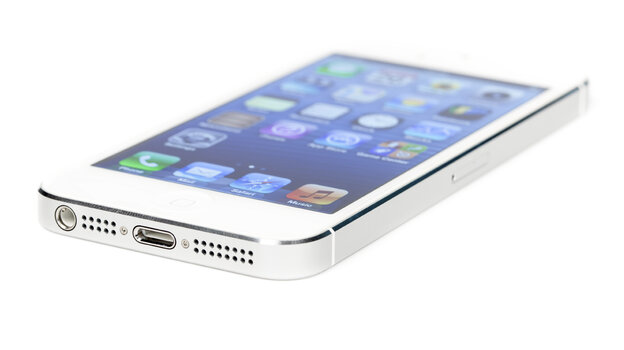
Apple has introduced these new guidelines for manufacturers that allow them to build headphones that connect to an iPhone or iPad through the Lightning connector. That's the same small connector on the bottom of an iPhone or iPad that is currently used to charge the device. Apple first introduced the connector a couple years ago with the iPhone 5 to replace its old 30-pin connector.
Now that Apple is allowing companies to build headphones that connect with the Lightning connector, that might be the first hint that Apple could remove that old, legacy headphone jack from devices down the road.
Even the hint or rumor of something like this seems to put a scare in markets, right? Because essentially you can leave a bunch of devices orphans when they change technology. Everyone else's devices can become obsolete.
It's a possibility. If we look at past examples of similar things Apple has done, usually they come out with an adapter solution that will allow these new Lightning headphones to work with your legacy device that still uses the headphone jack or vice versa. I'd imagine we'll see solutions like that at least for a few years, until people make the transition to the new technology.
The speculation is heightened, because Apple just paid around $3 billion for the headphone company Beats Electronics. Does this news help make sense of that deal?
Certainly, if the new Lightning headphones are something that Apple is going to push as its next innovation in audio. That'll, I imagine, be something that trickles down to Beats, and I imagine Beats would come out with a pair of Lightning headphones. We'll have to see where Apple takes it and what manufacturers do with it.
There was a lot of speculation that the Beats deal was more about the streaming music service, but I think that Apple has made it pretty clear that they're also interested in the headphones side of the business. If they are really interested in pushing these new Lightning headphones, I think Beats would be the perfect outlet to do that.
Obviously, this goes way beyond Apple, right? You're talking about a legacy technology — the headphone jack — that's been around for ages. What's the reason for Apple fiddling around with it?
I think that the Lightning connector does provide some benefits to headphone manufacturers. One of those is the ability to draw power from the iPhone. Right now, when a company makes a pair of headphones that have high-end audio processing features like active noise cancellation, they actually have to build a battery into the headphones. With the Lightning connector, they'll be able to draw power from the device itself. That could save manufacturers money and bring these high-end audio features to cheaper headphones. So it might be a win for consumers at the end of the day, depending on what manufacturers do with the technology.
How big a deal is it when Apple moves from an industry standard?
They've never been shy about doing it in the past — the disk drive on their Macbooks, the Flash in the browser on their iPhones. It does cause a bit of a stink among consumers and reviewers when the change first happens, but Apple usually tries to be ahead of the curve and predict what technologies are going to become legacy technologies. And with the examples we've just mentioned, they've been successful with it.

Monday, 14 July 2014

Here comes Generation Mobile - Are You Ready For What Comes After Gen Y?


There is naturally a lot of focus right now about the millennials, the so-called Generation Y - Gen Y for shorthand - and the implications for societies and the workplace as these new digitally aware citizens grow to become the leaders of tomorrow.
For those not familiar with the term, Gen Y generally refers to people born roughly between the early 1980s and the early 2000s. You can read some of my thoughts about the impact of Gen Y in a previous post of mine on here.
They are the first generation, certainly at the later end of that date range, to be born into a digital rather than analogue world and to grow up using technology as part of their everyday lives and not just something that is in the workplace.
But what comes after Gen Y and are we ready for them? On a superficial level what do we even call this next generation? The newspaper USA Today and, separately, the Pew Research Centre have been running contests to try and find a name for them other than simply 'Generation Z'. Some of the suggestions include iGeneration, @generation, the Swipe Generation and the Tweennials.
Whatever we end up calling this generation, they are going to have a transformative effect on the world around us as they move into adulthood. Their coming of age is starting to happen now, peaking around 2020. This is a generation that is not only growing up with digital interaction but also with a more mobile-first mindset as those interactions take place on smartphones and tablets.
What made me think about this was an interesting US-based study just published, calledSpeak Up, as part of Project Tomorrow. The study is mainly about the use of mobile technology in education but the results highlight some noteworthy trends among young kids today that will have implications for consumer trends, society, business and government as they grow older.
The study polled 3.4 million students, teachers, administrators and parents about the use of tech in education. Here are some of the most interesting stats from the research that highlight how much mobile is a part of their lives (and bear in mind that these stats relate only to access in school). When the home environment is also factored in I would expect these figures to be even higher.
  • 41 per cent of K-2 students (ages 6-7) have access to a tablet.
  • Half of students in elementary grades 3–5 (ages 8-11) have access to a smart phone, and 58 per cent have access to a tablet.
  • 73 per cent of middle school students (ages 11-14) have access to smart phones, 61 per cent have access to tablets.
  • 89 per cent of high school students (ages 14-18) have access to smartphones, yet only 50 per cent have access to a tablet.
The study also reveals some insight into future social media trends with students reporting less regular interaction with traditional social networking sites like Facebook. Meanwhile almost half (44 per cent) of students in grades 6-12 report using social media apps like Instagram, Snapchat and Vine. Nearly a third of high school students report using Twitter.
Given the evolution of social media over the past five years we may well see another start-up turn into a market-dominating giant like Facebook or Twitter but these stats seem to show the primary and middle school students favouring more instant and mobile app friendly social media over the likes of Facebook. If that is true that will have an impact on consumer trends and how brands and marketers will need to target those people.
Back to that contest to name so-called Generation Z - I propose Generation Mobile. Do you agree?

Sunday, 29 June 2014

Why Apple’s Beats Acquisition May Be Its Smartest Move Yet


The most talked-about “secret” of 2014 was Apple’s $3 billion acquisition of Beats. Although it wasn’t officially announced until May 28, rumors swirled around the Internet for weeks.

Apple now owns Beats Electronics (the makers of the headphones and speakers) and Beats Music, a streaming service similar to Pandora and Spotify. Apple has also added Dr. Dre and Jimmy Iovine to its executive roster, though their roles have not yet been clarified publicly.
This turn of events represents a dynamic new era in Apple’s relationship with the music industry and with music fans.
The Beats Deal Goes Way Back
This isn’t the first time Apple has redefined the music industry. According to Moses Avalon, a music business analyst, this is a move the company has wanted since the inception of iTunes.
“For over a decade, Apple and the major labels have hated one another,” Avalon writes on hiswebsite. “Labels hated Apple for forcing universal pricing — every song being the same price — and for being an enabler to the destruction of their main model: the album.”
Avalon says that at one point, Universal threatened not to renew Apple’s music licenses if Apple didn’t allow variable pricing. Steve Jobs gave in, but Apple has been trying to escape Universal’s hold ever since.
“Insiders should know that a perpetuity license for content is what Apple is really buying today for $3.5 billion,” says Avalon. “Not a bunch of code they could write themselves in a weekend.”
Under my watch at the dawn of Apple’s earliest music initiatives, we were industry-facing — primarily ensuring that Macs were sold to artists and creative teams across entertainment. We launched the home studio movement with the Mac and Pro Tools to enable artists to have greater creativity and flexibility. When iTunes launched — coupled with the iPod and subsequent Apple products — an ecosystem was created that enabled millions of music lovers to integrate music into their lifestyles. These developments also helped breathe new life into the record industry by creating new channels of distribution and monetization for artists.
Both of these were critical milestones for the music industry, and this is the third chapter. Here are a few reasons why it might just be Apple’s smartest move yet:
1. Apple Has Talent
Jimmy Iovine and Dr. Dre come with powerful industry pedigrees that will attract even more artists to Apple’s unique talent pool. This is a huge draw for artists trying to connect with their fan base, which includes 800 million iTunes users and 40 million iTunes radio listeners. With Jimmy and Dre, artists will want to engage with Apple even more actively than they have to this point.
Apple will have more influence on artists, labels, and other members of the music industry ecosystem to create dynamic new models of distribution and monetization. The combination of tech innovation, visionary leadership, relationships, and industry credibility can’t be underestimated.
2. Apple Has Taste
One of the most enticing aspects of the deal is that Beats Music focuses on music curation by using real humans instead of algorithmic music discovery. Beats supports the discovery of music through sharing playlists of experts in listeners’ favorite musical genres. It offers suggestions based on artists users like, music they’ve listened to, and mood-relevant discovery through The Sentence.
The addition of Beats enhances Apple’s music offerings that integrate free streaming with iTunes Radio by now incorporating a music subscription service via Beats Music. Combined with the iTunes Store, it’s a powerful triad of services offering the industry multiple channels of distribution and monetization. Apple can also extend the Beats Music curation offering to iTunes Radio, which could close the UX gap with competing services in the market. In addition, the marketing buzz generated by the Apple/Beats deal could lure more listeners to iTunes Radio.
3. Apple Has Diversity
Apple’s strength has always been its ability to seamlessly integrate software and gadgets. Beats may be part of Apple’s foray into wearables. Elias Roman, CEO of Songza, suggests that Beats could be Apple’s Google Glass.
Apple has the iTunes experience, retail stores, and hardware devices, which now include Beats headphones. If Apple links all these facets well, it will become a juggernaut that few will be able to compete with.
4. Apple Has Deep Pockets
Because Apple makes plenty of revenue through the sales of its devices, it can afford to operate Beats Music at a loss. By providing a comprehensive solution that competing streaming services can’t, Apple can more easily devalue services such as Pandora and Spotify.
This could quickly lead to smaller services that have fewer subscribers and less marketing muscle quickly disappearing. Apple will deliver powerful marketing and offer bundled product and service discounts to amplify their new suite of offerings.
5. Apple Has Experience
Apple is the ultimate disruptor of the music industry, and Jimmy Iovine and Dr. Dre are known as disruptors themselves. Steve Jobs was the first person to broker a workable deal with the music industry during the post-Napster era, when piracy nearly overtook the old music business model.
Apple practically reinvented the music industry as we know it today, and the Beats acquisition is the first step toward curating that industry. Anything is possible if the right set of creative strategies and market navigations are executed — and there is every reason to believe they will be.
Apple’s acquisition of Beats has many guessing the next move of this tech giant. Adding well-known music industry veterans to the iTunes team shows that Apple is embracing artist-centric activities and contemplating even more creative ways to allow artists to monetize their relationships with fans by capitalizing on the growing artist-to-fan engagement trend.
This latest move may be the first of many steps toward the company reinforcing and extending its domination of music and entertainment. As a result, it will secure a greater market share, increase its revenues, and provide additional avenues for fans to discover and enjoy the music experience.