Showing posts with label cloud computing. Show all posts

Sunday, 20 July 2014

6 Amazing Advances in Cloud Technology

The cloud is more than just dirt-cheap data storage and lightning-fast apps. These six innovations show that it's possible to manage servers, develop applications, run virtual machines and even sequence the human genome using cloud technology.

Nothing ever changes in the cloud, right? That might seem to be the case if, say, a company starts using Box for sales presentations or relying on one of the many online accounting device that works from anywhere and manages the security for you. Many of these systems are maturing and don't make radical improvements — and that's often a good thing.However, innovations do pop up. Many, including the six discussed below, could impact your business this year.

Genetic Sequencing

Using powerful supercomputers to help with cancer research isn't exactly new — but moving the scientific calculations to the cloud marks a major undertaking. Analyst Charles King says this is a significant project in two major ways: One, it's try to understand the genomic sequencing that occurs in brain cancer patients, and two, it's showing how the cloud is maturing. The cloud-based version of IBM Watson can scan databases and learn how to customize treatments to patient DNA.
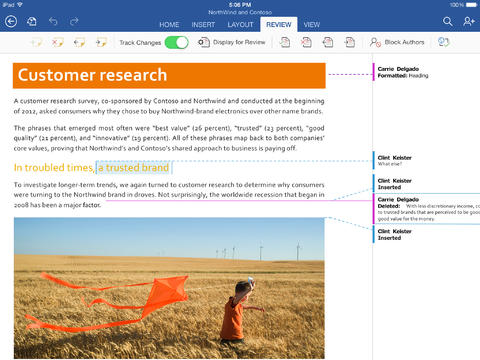
Microsoft Word for iPad

This advancement might not seem that world-changing, although it's surprising that Microsoft has finally launched Office apps on the Apple iPad. What is game-changing for business users: The apps sync securely to the cloud. The apps are also free for business users who've already standardized on Office 365 and pay the monthly Web usage storage fees. Importantly, the apps were designed for tablet use, meaning they support swiping and other gestures.

Basic6

Using a console to manage cloud servers and data center services in one view lets you accomplish tasks such as managing accounts, setting passwords and controlling Amazon Elastic Compute Cloud (EC2) features.
The main innovation with Basic6, though, is that the dashboard works in real-time for services such as Box and AWS at the same time. Most features are managed using a tree structure on the left pane. The console maintains an audit trail of exactly which changes were made to which cloud services.

Box View

Writing code for the cloud might be about as dull as a routine health exam, but Box is making it as easy as possible. One innovation, Box View, essentially gives even nonprogrammers a way to upload a business document and create rich HTML sites with an embedded document viewer. It's also a sign of things to come — that is, the cloud will continue to evolve in terms of developing custom apps and features that match business needs.

Amazon WorkSpaces

Offering a virtual desktop to employees has always presented one great IT challenge: Making sure the desktop is always available and tuned for speedy performance. Amazon recently started offering WorkSpaces, a cloud-based desktop that runs on laptops and tablets.
The main innovation of Amazon WorkSpaces concerns network optimization using Amazon Web Services; this provides the same kind of availability you've come to expect from a cloud storage service or custom application.

SmartVue

Video surveillance in a corporate setting is a different beast from home surveillance; there are likely policies about encrypting the signal, storing the recorded video and managing the cameras, among other things. The Smartvue cloud surveillance servers lets you view and manage cameras from a Web browser. Security cameras installed on premises can link to the cloud server for policy management, storage and security controls — and many third-party cameras will work just fine.

Sunday, 13 July 2014

Microsoft Rushes to Fix Browser After Attacks; No Fix for XP Users

BOSTON — Microsoft Corp is rushing to fix a bug in its widely used Internet Explorer web browser after a computer security firm disclosed the flaw over the weekend, saying hackers have already exploited it in attacks on some U.S. companies.
PCs running Windows XP will not receive any updates fixing that bug when they are released, however, because Microsoft stopped supporting the 13-year-old operating system earlier this month. Security firms estimate that between 15 and 25 percent of the world's PCs still run Windows XP.
Microsoft disclosed on Saturday its plans to fix the bug in an advisory to its customers posted on its security website, which it said is present in Internet Explorer versions 6 to 11. Those versions dominate desktop browsing, accounting for 55 percent of the PC browser market, according to tech research firm NetMarketShare.
Cybersecurity software maker FireEye Inc said that a sophisticated group of hackers have been exploiting the bug in a campaign dubbed "Operation Clandestine Fox."
FireEye, whose Mandiant division helps companies respond to cyber attacks, declined to name specific victims or identify the group of hackers, saying that an investigation into the matter is still active.
"It's a campaign of targeted attacks seemingly against U.S.-based firms, currently tied to defense and financial sectors," FireEye spokesman Vitor De Souza said via email. "It's unclear what the motives of this attack group are, at this point. It appears to be broad-spectrum intel gathering."
He declined to elaborate, though he said one way to protect against them would be to switch to another browser.
Microsoft said in the advisory that the vulnerability could allow a hacker to take complete control of an affected system, then do things such as viewing changing, or deleting data, installing malicious programs, or creating accounts that would give hackers full user rights.
FireEye and Microsoft have not provided much information about the security flaw or the approach that hackers could use to figure out how to exploit it, said Aviv Raff, chief technology officer of cybersecurity firm Seculert.
Yet other groups of hackers are now racing to learn more about it so they can launch similar attacks before Microsoft prepares a security update, Raff said.
"Microsoft should move fast," he said. "This will snowball."
Still, he cautioned that Windows XP users will not benefit from that update since Microsoft has just halted support for that product.
The software maker said in a statement to Reuters that it advises Windows XP users to upgrade to one of two most recently versions of its operating system, Windows 7 or 8.

Wednesday, 9 July 2014

Change your company culture and get onto the cloud

Now that cloud computing is the new normal, it's the company culture -- not technology -- holding back the cloud

Technology issues don't typically stop cloud implementations. More often than not, it's the people. Office politics, unrealistic expectations, and general stupidity are the common culprits that hinder cloud computing use at many enterprises.
The vocal opponents to cloud computing we heard in 2008 are mostly quiet in 2014. However, they are still lurking. Today, they use closed-door conversations to call the cloud into question, often for the wrong reasons. By doing so, they create a toxic culture around the use of cloud computing -- or any new technologies that may prove to be innovative and helpful but threaten the status quo.
[ From Amazon Web Services to Windows Azure, see how the elite 8 public clouds compare in the InfoWorld Test Center's review. | Stay up on the cloud with InfoWorld's Cloud Computing Report newsletter. ]
Today, cloud computing has real momentum. Projects are beginning to ramp up, despite opposition around the use of public cloud resources. However, if a business pushes cloud computing onto an IT culture that simply won't have it, the project becomes so difficult that it is likely to fail.
To change such toxic cultures, many CIOs have simply fired those who are impeding progress. But while you can certainly scare people into agreeing with you (at least publicly), doing so is counterproductive. You end up trading a culture problem for a morale problem. I would rather have the culture problem.
Changing hearts and minds around the use of any technology is a process that begins with engaging everyone in the evaluation and implementation of the technology. Create a small, ad-hoc team of cloud computing skeptics and task them with "getting to the truth" around the value of this technology, including working a small proof-of-concept cloud project -- for example, the implementation of a small storage system or another option that can be accomplished quickly with only a small amount of risk.
You'll likely see certain results. First, those given the power to evaluate cloud computing for the company are likely to take the task to heart and provide a sound evaluation of the technology, including both the pros and the cons. Second, they are likely to feel empowered, and therefore open their minds a bit around the use of new technology, namely cloud computing. Finally, you'll get some good data around the work that's done and can use that information to adjust your cloud plans.
If you're faced with a "no cloud, no way" culture, try this approach. Change takes time, and most people will eventually come around if given the chance. And never forget that their arguments might include some valid points. You need to acknowledge that.